Is Your Data Ready for Black Friday?
Peak season amplifies everything. Orders, revenue, and every data problem you haven't dealt with yet.
Black Friday and the Christmas run-up are when eCommerce businesses make their numbers. They are also the pressure points when every unresolved data problem gets expensive. A checkout that frustrates customers in March frustrates ten times as many in November. Customer databases with address errors that generate a handful of failed deliveries in a quiet month generate hundreds during peak season. The volume doesn’t create the problem; it just makes the one that was already there impossible to ignore.
Most preparation for the busy season focuses on inventory, fulfilment, and marketing. Data rarely makes the list, despite being the foundation that checkout conversion, delivery success, and post-purchase communication all depend on. It's far easier to get it right before the season starts than trying to manage the fallout when it doesn't.
Here is what is worth checking, and why it matters now rather than in January:
Your checkout validation
A slow, clunky checkout chips away at your conversion rate. Validation fixes that: fewer drop-offs, more trust at the point of purchase. Autocomplete that works quickly keeps the customer moving, postcode lookup draws on current Royal Mail PAF data to catch new builds and recent changes, and email and phone validation means everything sent to the customer after checkout actually reaches them. When customers are buying quickly on mobile and have less patience for friction, the difference between a checkout that validates smoothly and one that fights back is measurable in conversion rate.
Now is the time to actually test it. Run a few test addresses through your checkout. Try a postcode for a new development in your area. Check how it handles a flat number or a building name. If any of those cause problems in a test, they will cause problems for real customers during your busiest week of the year.
Your customer database
If you send email campaigns, remarketing lists, or direct mail appeals ahead of peak season, then the quality of your customer database determines how much of that effort actually reaches anyone.
Contact data decays at around thirty percent per year. For a database that hasn't been cleansed recently, a significant proportion of your records may have postal addresses, email addresses, or phone numbers that are no longer current. Running a campaign to a list in that state means a portion of every send goes nowhere, and the customers it was supposed to reach simply don't receive it.
A data cleanse is one of the highest-return activities an eCommerce team can do approaching Black Friday. It costs a fraction of a campaign budget, and it means the campaign budget actually works. Reactivation revenue attributed to a cleaned list is real. Revenue attributed to a list with thirty percent decay baked in is partly wishful thinking.
The average cost of a failed delivery is £11.60. Multiply that by peak season volume and the cost of an uncleansed database becomes concrete very quickly.
From checkout to doorstep
A validated address gets a parcel to the right building. What happens after that depends on whether your delivery partner can actually reach the customer. Tracking notifications, delivery window confirmations, and access instructions all depend on a live email address and a working phone number.
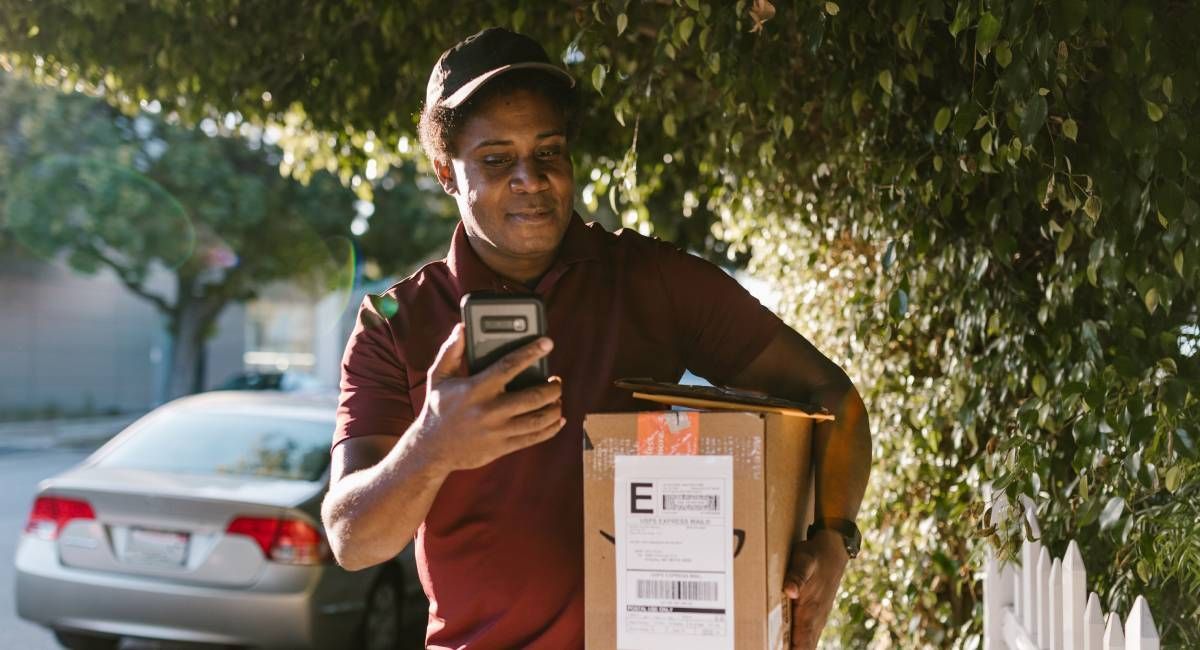
When carriers are operating at capacity over the Christmas period, and redelivery slots are hard to come by, a failed first-time delivery attempt is more disruptive than at any other time of year. 70% of shoppers say they will not return to a retailer after a single delivery failure. When acquisition costs are at their highest and competition for customer loyalty is at its most intense, that retention risk matters more than usual.
Fetchify works alongside nShift, a delivery management platform connecting businesses to over 1,000 carriers across 190 countries through a single integration. Where Fetchify validates the address, email, and phone data at the point of capture, nShift handles carrier selection, tracking, and returns on the other side. nShift's own data shows a 20% increase in checkout conversion and up to 60% fewer customer queries about order status when both parts of the chain are working properly.
For businesses managing multiple carriers or shipping cross-border, having both the data and the delivery layer operating reliably removes two of the most common causes of failures at the worst possible time.
When a postcode isn't enough
For customers who have recently moved into new developments, apartment buildings, or multi-occupancy properties, standard postcode lookup often doesn't recognise their exact address, or returns results that don't include their flat or unit number. It's a data gap that exists year-round, and at high order volumes it becomes harder to absorb. Fetchify's Multiple Residence Data covers over 900,000 properties of this type, and Not Yet Built Data covers a further 700,000 UK properties in planning or under construction, so addresses for new developments are available before they appear in Royal Mail's main database.
Even for addresses that do exist in the database, a postcode doesn't always get the driver to the right door. For rural properties, large sites, or new developments where postcodes cover a wide area, the pin a courier app drops is often an estimate. Fetchify's Rooftop Geocodes provide precise latitude and longitude coordinates for the property itself, giving courier apps and delivery software a precise pin to work from rather than an approximation. Insurers and councils already use the same kind of data to understand access and risk at property level. For delivery, it's the same principle applied earlier in the chain.
When to act
Fail to plan, then plan to fail. Black Friday and Christmas are the busiest sales periods of the year, and they are coming fast. Whether it is email addresses, phone numbers, or postal details, a single wrong entry multiplies quickly at peak volume: a bounced confirmation or a failed delivery right when it matters most.
If any of the above has prompted a question about your own setup, the right time to look into it is now, while there is still time to act. The season rewards preparation and makes the absence of it expensive.
To see what a data cleanse actually looks like in practice, and what it changed almost overnight for one business that acted on it, read our Phoenix Insolvency case study
Get your data peak-season ready
Fetchify's validation and
data cleansing tools cover address, email, phone, and
UK bank account validation. Speak to the team at fetchify.com/contact or
start a free trial.